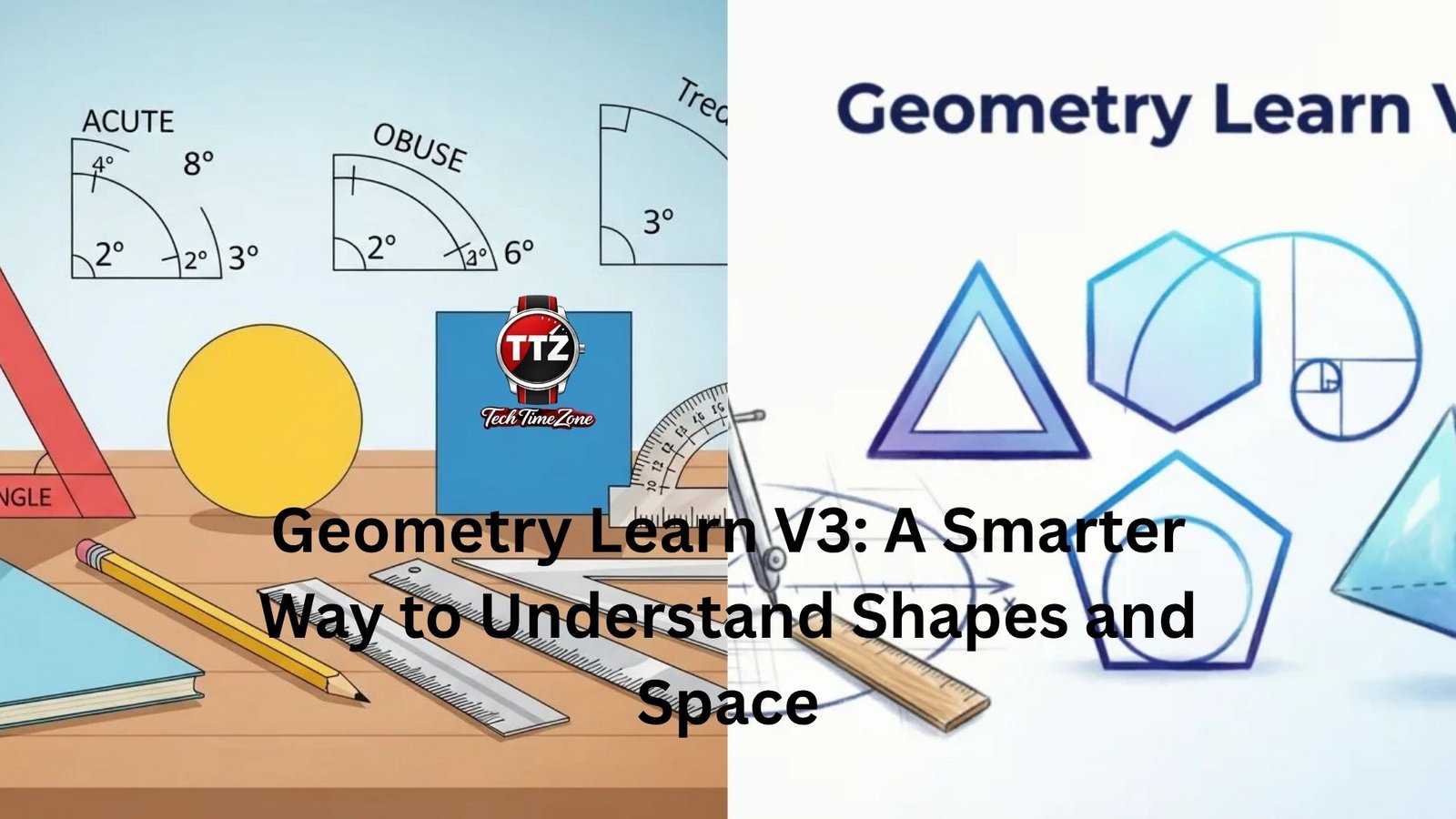
Geometry has a funny way of dividing people. Some students love it because it feels visual and logical. Others struggle because the moment angles, proofs, and formulas appear, everything starts looking confusing.
That’s where tools like Geometry Learn V3 come into the conversation.
Instead of treating geometry as a collection of rules to memorize, Geometry Learn V3 focuses on helping learners see how mathematical ideas work. And that simple shift can make a huge difference. When you can actually visualize relationships between shapes, lines, and measurements, geometry becomes far less intimidating.
Think about learning how to ride a bicycle. Reading instructions helps a little, but getting on the bike teaches you much faster. Geometry works in a similar way. Interactive learning often creates understanding that textbooks alone can’t provide.
Table of Contents
- What Is Geometry Learn V3?
- Why Geometry Feels Difficult for Many Students
- How Geometry Learn V3 Changes the Learning Experience
- Visual Learning Makes a Big Difference
- Exploring Shapes Through Interaction
- Building Confidence With Step-by-Step Learning
- Geometry Beyond the Classroom
- Common Topics Covered in Geometry Learn V3
- Who Can Benefit From Geometry Learn V3?
- Tips for Getting the Most Out of Geometry Learning Tools
- The Future of Interactive Geometry Education
- Final Thoughts
What Is Geometry Learn V3?
Geometry Learn V3 is an educational platform designed to help users understand geometry through interactive exploration and guided learning.
Rather than relying entirely on static diagrams, it allows learners to engage with geometric concepts in a more hands-on way. Shapes can be manipulated, measurements can be examined, and mathematical relationships become easier to observe.
For many students, this approach feels more natural.
A textbook might show a triangle and explain how angles work. An interactive learning environment lets you move points around and watch angle values change in real time. Suddenly, a concept that felt abstract starts making sense.
That’s one reason why platforms like Geometry Learn V3 have gained attention among students, parents, and educators.
Why Geometry Feels Difficult for Many Students
Let’s be honest. Geometry can seem straightforward at first.
A square has four sides. A circle is round. A triangle has three angles.
Simple enough.
Then things become more complicated. Proofs appear. Theorems arrive. Students are asked not only to find answers but also to explain why those answers are correct.
That jump can be challenging.
Many learners struggle because geometry often requires both visual thinking and logical reasoning at the same time. If either skill feels weak, the subject can quickly become frustrating.
Imagine looking at a complex floor plan for the first time. Someone familiar with architecture sees relationships and structure. Someone else might only see a collection of confusing lines.
Geometry learning tools help bridge that gap by making those relationships easier to see.
How Geometry Learn V3 Changes the Learning Experience
One of the strongest features of Geometry Learn V3 is its focus on active participation.
Instead of watching concepts from a distance, learners become part of the process.
When a student drags a point on a shape and instantly sees how measurements change, they’re discovering patterns for themselves. That discovery often sticks longer than memorized formulas.
Educational research has repeatedly shown that people tend to retain information better when they actively engage with it.
Think about learning directions in a city. You can study a map all day, but actually walking the streets creates a much stronger understanding.
Geometry Learn V3 follows a similar philosophy.
The learning experience becomes less about memorization and more about exploration.
Visual Learning Makes a Big Difference
Geometry is naturally visual.
That’s why visual learning tools can have such a powerful impact.
A student trying to understand parallel lines may read several paragraphs of explanation and still feel uncertain. Seeing those lines interact within a dynamic environment often provides instant clarity.
Here’s the thing.
Our brains are surprisingly good at recognizing patterns.
When geometric relationships become visible, learners often start connecting ideas on their own. They notice similarities between shapes. They identify angle relationships. They observe how transformations affect figures.
Those observations create deeper understanding than simple memorization ever could.
Many students who once believed they were “bad at math” discover that they simply needed a different way to approach the material.
Exploring Shapes Through Interaction
One of the most engaging aspects of Geometry Learn V3 is the ability to interact directly with geometric figures.
A rectangle isn’t just a picture on a page anymore.
You can adjust dimensions, compare measurements, and explore how changes affect area and perimeter.
The same applies to triangles, circles, polygons, and more advanced geometric structures.
This interactive approach encourages curiosity.
A learner might begin with a simple question:
“What happens if I move this point?”
That question often leads to several new discoveries.
Mathematics becomes less about finding the correct answer and more about understanding why certain relationships exist.
For many people, that’s when geometry starts becoming genuinely interesting.
Building Confidence With Step-by-Step Learning
Confidence matters more than most people realize.
Students who feel overwhelmed often stop engaging fully with the subject. Even capable learners can struggle when they become convinced that geometry is beyond their abilities.
Geometry Learn V3 addresses this issue by breaking concepts into manageable pieces.
Instead of presenting everything at once, lessons typically build progressively. Each idea supports the next.
Consider someone learning to play guitar.
Nobody expects a beginner to perform complex solos on day one. They learn basic chords first, then gradually develop more advanced skills.
Geometry works the same way.
When learners experience small successes consistently, their confidence grows. That confidence often leads to stronger performance across the entire subject.
Geometry Beyond the Classroom
People sometimes assume geometry only exists inside school textbooks.
In reality, geometric thinking appears almost everywhere.
Architects rely on geometry when designing buildings.
Engineers use geometric principles to solve structural challenges.
Graphic designers work with shapes, proportions, and spatial relationships every day.
Even simple daily activities involve geometric thinking.
Hanging a picture frame evenly. Measuring furniture before moving it into a room. Planning a garden layout.
These situations all involve spatial reasoning.
Geometry Learn V3 helps learners connect classroom concepts with practical applications. That connection makes the subject feel more meaningful.
When students understand where geometry appears in real life, motivation often increases naturally.
Common Topics Covered in Geometry Learn V3
Geometry Learn V3 typically focuses on foundational and intermediate geometric concepts that students encounter throughout their educational journey.
These often include:
- Angles and angle relationships
- Triangles and their properties
- Circles and circumference calculations
- Area and perimeter concepts
- Transformations and symmetry
- Coordinate geometry
- Polygons and geometric constructions
- Basic geometric proofs
The goal isn’t simply to cover these topics but to help learners understand the relationships between them.
Geometry isn’t a collection of isolated lessons.
Each concept connects to several others.
When students begin recognizing those connections, the subject starts feeling much more logical.
Who Can Benefit From Geometry Learn V3?
The obvious answer is students.
Yet the audience can be broader than many people expect.
Parents helping children with homework often find interactive geometry tools useful because they provide visual explanations that are easier to follow.
Teachers can use these resources to demonstrate concepts during lessons.
Adult learners returning to mathematics after many years may also benefit from a more visual learning environment.
I’ve seen plenty of situations where someone says, “I never understood geometry in school,” only to grasp a concept within minutes when presented visually.
Different learners absorb information in different ways.
Geometry Learn V3 recognizes that reality.
Tips for Getting the Most Out of Geometry Learning Tools
Using an educational platform effectively requires more than simply opening it and clicking around.
A few habits can significantly improve results.
Start by exploring concepts slowly. There’s no need to rush through lessons.
Experiment with shapes whenever possible. Move points. Change dimensions. Test ideas.
Ask questions while learning.
Why did that angle change?
Why did the area increase?
Why do those lines stay parallel?
Curiosity often leads to deeper understanding.
It’s also helpful to connect digital activities with traditional problem-solving. Solving exercises after exploring concepts can reinforce what you’ve learned.
Most importantly, don’t worry about making mistakes.
Mistakes frequently reveal valuable insights.
Many mathematical discoveries begin with someone testing an idea that doesn’t work as expected.
The Future of Interactive Geometry Education
Educational technology continues evolving rapidly.
Students today have access to tools that were almost unimaginable a generation ago.
Interactive geometry platforms represent part of a larger shift toward experiential learning.
Rather than passively receiving information, learners actively engage with concepts.
That trend is likely to continue.
Future versions of geometry learning tools may include even more advanced visualization features, personalized learning paths, and enhanced feedback systems.
The core principle, however, will probably remain the same.
People learn best when they can see, explore, and experiment with ideas for themselves.
Geometry Learn V3 reflects that philosophy in a practical and accessible way.
Final Thoughts
Geometry Learn V3 offers a refreshing approach to a subject that many learners find challenging. By combining visual learning, interaction, and step-by-step exploration, it helps transform geometry from a collection of confusing formulas into something far more understandable.
The real value isn’t just learning how to calculate angles or measure shapes. It’s developing the ability to think spatially, recognize patterns, and solve problems logically.
Those skills extend far beyond mathematics.
Whether you’re a student preparing for exams, a parent supporting a child, or simply someone interested in understanding geometry more clearly, interactive learning tools can make the journey much smoother.
Sometimes all it takes is seeing a concept from a different angle. When that happens, geometry stops feeling like a puzzle and starts feeling like a language you can finally understand.