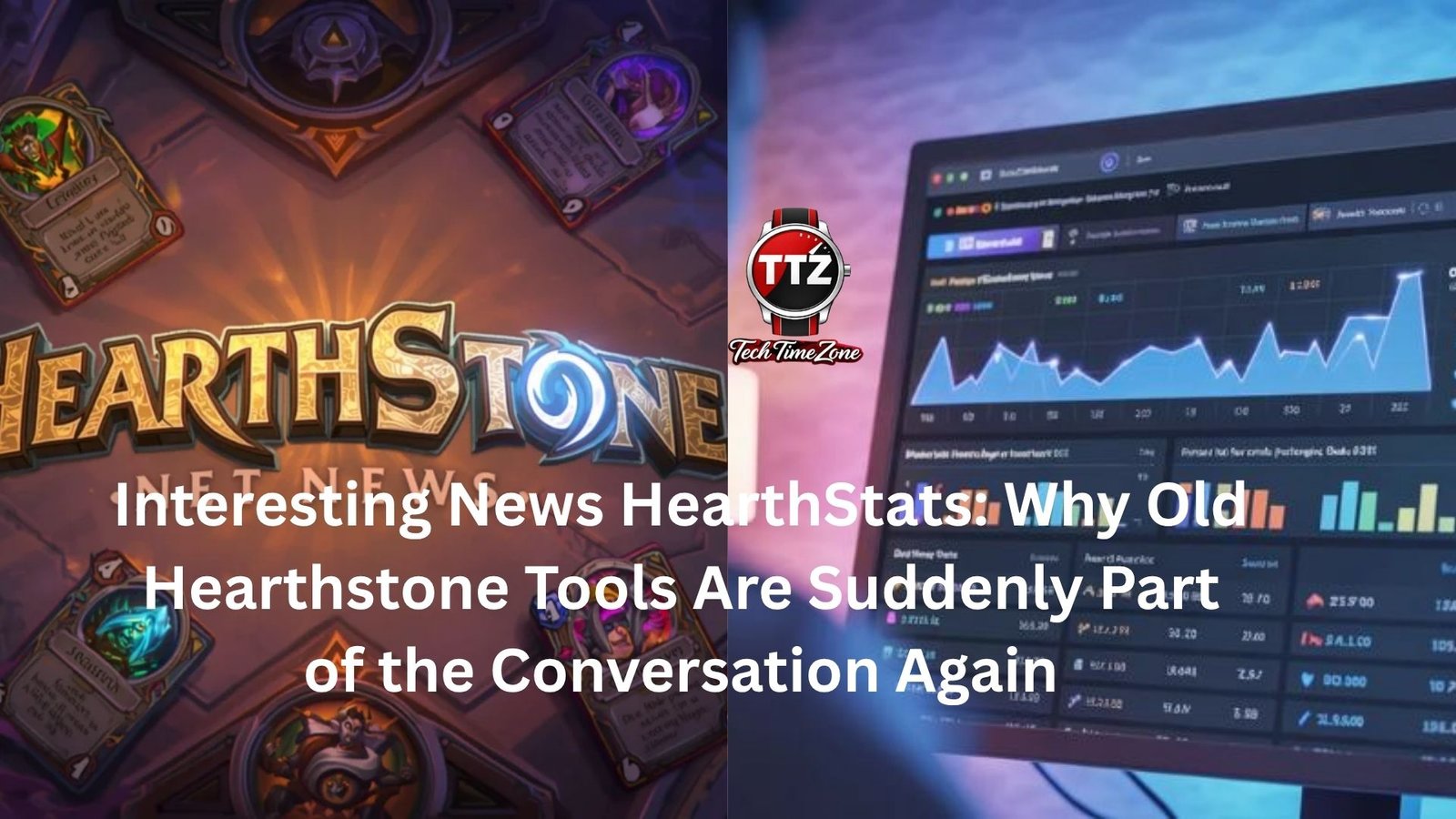
For a website many players assumed was long gone from relevance, HearthStats has been popping up in conversations again in a surprisingly interesting way.
Not because it suddenly became the biggest Hearthstone tracker on the internet. That ship sailed years ago. But because players have started looking backward at what made older community tools feel more useful, more personal, and honestly… more fun.
That says a lot about where online gaming communities are right now.
If you played Hearthstone during its earlier years, there’s a decent chance you remember HearthStats. It was one of those companion sites people used to track decks, win rates, matchups, and ranked progress before Blizzard’s own in-client systems became more detailed. Back then, players relied heavily on fan-made tools. Some were rough around the edges. Some broke after patches. But they had personality.
Now, with renewed discussions around game data ownership, community-built platforms, and nostalgia for “simpler” online gaming spaces, HearthStats keeps getting mentioned again. Not as a comeback giant, but as a symbol of something players think modern gaming lost along the way.
And honestly, they might have a point.
Why HearthStats Still Matters to Some Players
The funny thing about gaming tools is that people rarely miss them until they disappear.
At the time, HearthStats felt practical. You uploaded matches. You tracked decks. You compared performance across classes. Pretty standard stuff today. But years ago, it felt groundbreaking because Hearthstone itself gave players almost none of that information.
You had to remember your own win rates manually. Most people didn’t. A lot of ladder decisions were based entirely on feeling.
Then tools like HearthStats showed up and suddenly players could say things like:
“Wait, I only think my Priest deck is good.”
That changed how people approached the game.
Instead of relying on memory — which is terrible during losing streaks — players could look at actual numbers. Turns out the “unbeatable” deck you loved might have been sitting at a 46% win rate the whole time.
That kind of reality check helped players improve fast.
But there’s another reason people remember HearthStats fondly: it felt community-driven rather than corporate-managed. That distinction matters more than companies sometimes realize.
Modern gaming ecosystems are polished. Efficient. Integrated.
They’re also often sterile.
Older gaming sites felt messy in a human way. Forums were chaotic. Deck discussions were weirdly passionate. People uploaded experimental builds with terrible names like “Dragon Pain Final FINAL v2.”
And somehow that was part of the charm.
The Bigger Story Isn’t About HearthStats
Here’s where things get more interesting.
The recent chatter around HearthStats isn’t really about the platform itself. It’s about what gaming communities are starting to value again.
Players are exhausted by overly optimized gaming culture.
Every multiplayer game now has instant meta reports, algorithmic rankings, automated overlays, data mining, and content creators telling you the mathematically perfect build within hours of a patch going live. Efficiency dominates everything.
That has benefits, obviously. Competitive players love having information quickly.
But there’s a downside nobody talks about enough: discovery disappears.
Older Hearthstone eras felt slower. You experimented more because there wasn’t always a perfect answer waiting on YouTube ten minutes after expansion launch.
A friend of mine used to spend entire weekends testing absurd Freeze Mage variations that absolutely should not have worked. Most failed horribly. One somehow carried him to Legend.
That kind of experimentation happens less now because the internet solves games at incredible speed.
So when people bring up HearthStats these days, they’re often expressing nostalgia for a gaming culture that felt less optimized and more exploratory.
Not necessarily better overall. Just different.
Data Tracking Changed Competitive Gaming Forever
It’s impossible to overstate how much stat-tracking tools transformed card games.
Before platforms like HearthStats became popular, players relied heavily on instinct. Some top-level competitors kept handwritten notes. Others used spreadsheets manually. Most casual players tracked nothing at all.
Now? Even average-ranked players talk about sample sizes and matchup percentages like junior analysts.
That shift spread far beyond Hearthstone.
You can see the influence everywhere:
- League of Legends build trackers
- Valorant stat overlays
- TFT analytics
- Marvel Snap deck databases
- MTG Arena trackers
Players expect data now. They want proof.
And honestly, that changes how games feel emotionally.
A losing streak hits differently when a tracker shows you went 4–11 against one deck archetype. Suddenly it’s not “bad luck.” It’s a matchup problem.
That can reduce frustration. It can also make games feel colder.
Sometimes ignorance really was bliss.
Blizzard’s Relationship With Community Tools Has Always Been Complicated
One reason HearthStats became notable in the first place was because Blizzard left gaps for community developers to fill.
That strategy worked beautifully for years.
Fans built deck trackers, tournament overlays, replay systems, arena assistants, and statistical databases because players wanted them badly enough to create them for free.
But there’s always tension when unofficial tools become essential.
Game developers want consistency and security. Communities want customization and freedom. Those goals don’t always align.
Over time, Blizzard improved Hearthstone’s own tracking systems while third-party tools evolved into increasingly advanced ecosystems. Some survived. Others faded away when maintenance became difficult or user habits changed.
HearthStats eventually lost momentum as competitors expanded features faster and integrated more deeply into the modern Hearthstone scene.
That’s normal in tech. Very few early platforms stay dominant forever.
Still, people remember who got there first.
Nostalgia Is Powerful — But It’s Not Always Wrong
Gaming nostalgia gets mocked constantly online.
Someone mentions “the old days,” and immediately another person says players are just blinded by childhood memories.
Sometimes that’s true.
But not always.
There are legitimate reasons older online gaming spaces felt more connected.
Smaller communities forced interaction. You recognized usernames. Deck creators developed reputations. Forum arguments lasted for months. It was chaotic, but communities developed personality.
Today’s systems are larger and more efficient, yet often strangely forgettable.
A lot of modern gaming experiences feel interchangeable because algorithms flatten everything into optimized content delivery.
That’s partly why niche discussions around HearthStats keep resurfacing. People aren’t literally asking for a 2015 website experience again. They’re reacting to a broader feeling that modern gaming became too streamlined.
Here’s the thing: friction sometimes creates identity.
When tools were slightly awkward, communities collaborated more. Players shared discoveries because information wasn’t instantly centralized.
Now information spreads so quickly that individual discovery has less social value.
Hearthstone Itself Is in a Strange Place
Another reason older tools are getting attention again is because Hearthstone’s player culture has shifted dramatically.
The game still has a loyal audience. Expansion launches still create spikes of excitement. But the atmosphere is different now compared to its explosive early years.
Back then, Hearthstone felt like a social phenomenon.
People played at college cafeterias, during work breaks, on public transit. Streamers exploded in popularity because viewers were learning the game alongside them. Every new legendary card sparked debates that lasted weeks.
Today the game is more mature. More systems exist. More modes. More complexity.
That’s good in some ways. But it also means newer players face a harder entry point.
Ironically, old-school tools like HearthStats represented a time when players were collectively figuring things out together. There’s emotional value in that memory.
You can feel it whenever veteran players start sharing old screenshots online. Ancient decklists. Ridiculous metas. Broken combos everyone hated at the time but laughs about now.
Nobody misses getting destroyed by Undertaker Hunter. But they miss talking about it.
That’s different.
The Return of Community-Centered Gaming
One genuinely interesting trend lately is the growing appetite for smaller, community-driven gaming spaces.
Discord groups are replacing giant forums. Independent stat sites are gaining niche audiences again. Players increasingly trust passionate community curators over giant generalized platforms.
Even outside Hearthstone, people are gravitating toward:
- fan-run tournaments
- specialized strategy communities
- independent databases
- creator-led game analysis
There’s less faith that giant companies alone create the best player experiences.
That doesn’t mean old platforms automatically deserve revival. Technology moved on for good reasons.
But the emotional need those sites fulfilled never disappeared.
Players want spaces that feel inhabited by actual enthusiasts rather than engagement algorithms.
And yes, that sounds dramatic for a digital card game. But gaming communities matter to people. They become routines. Friend groups. Competitive outlets after work. Tiny pieces of everyday life.
A deck tracker can end up carrying weird emotional nostalgia because of the period of life attached to it.
Anyone who spent late nights climbing Hearthstone ladder in 2016 probably knows exactly what I mean.
What Modern Developers Could Learn From It
The HearthStats conversations also expose an important lesson for game studios.
Players don’t just want polished systems. They want ownership and participation.
The most beloved gaming communities usually leave room for players to build culture around the game rather than consuming everything passively.
That’s why moddable games survive forever. Why fan wikis become massive. Why unofficial APIs create thriving ecosystems.
Communities enjoy contributing.
When everything becomes too controlled, games risk feeling transactional instead of communal.
Older companion tools succeeded because they made players feel involved in shaping the experience.
You weren’t just using HearthStats. You were contributing data, sharing decks, discussing trends, helping define the meta.
That participation mattered.
Modern live-service games sometimes forget that players don’t only want convenience. They also want meaningful connection to the ecosystem surrounding the game.
The Funny Reality About Gaming History
Most gaming tools disappear quietly.
Servers shut down. Databases vanish. URLs stop working. Communities migrate somewhere else.
Very few leave behind lasting emotional memory.
The fact people still bring up HearthStats years later means it mattered more than raw traffic numbers would suggest.
Not because it was perfect. Definitely not because it was flashy.
It mattered because it arrived at exactly the right moment in Hearthstone history — when players were hungry for ways to understand a rapidly growing game together.
That combination is hard to recreate artificially.
Gaming companies spend millions trying to manufacture “community,” but genuine community usually forms organically around shared curiosity. HearthStats benefited from that energy at exactly the right time.
And now, years later, people are realizing they miss that feeling more than they miss the tool itself.
Final Thoughts
Interesting news around HearthStats isn’t really about an old stats website making a dramatic return. It’s about a shift in how players think about gaming culture.
People are questioning whether hyper-optimized gaming ecosystems actually improve long-term enjoyment. They’re remembering a period when experimentation felt more valuable and communities felt more personal.
That doesn’t mean gaming should move backward.
Nobody truly wants to return to unstable tools, missing features, and terrible interfaces just for nostalgia’s sake.
But there’s something worth paying attention to in these conversations.
Players still crave discovery. They still want community spaces with personality. They still enjoy feeling like participants rather than data points inside endlessly optimized systems.
HearthStats happened to represent that era for a lot of Hearthstone fans.
And honestly, in a gaming world increasingly dominated by automation and instant meta solving, it makes sense that people are looking back at those older community-driven experiences with fresh appreciation.