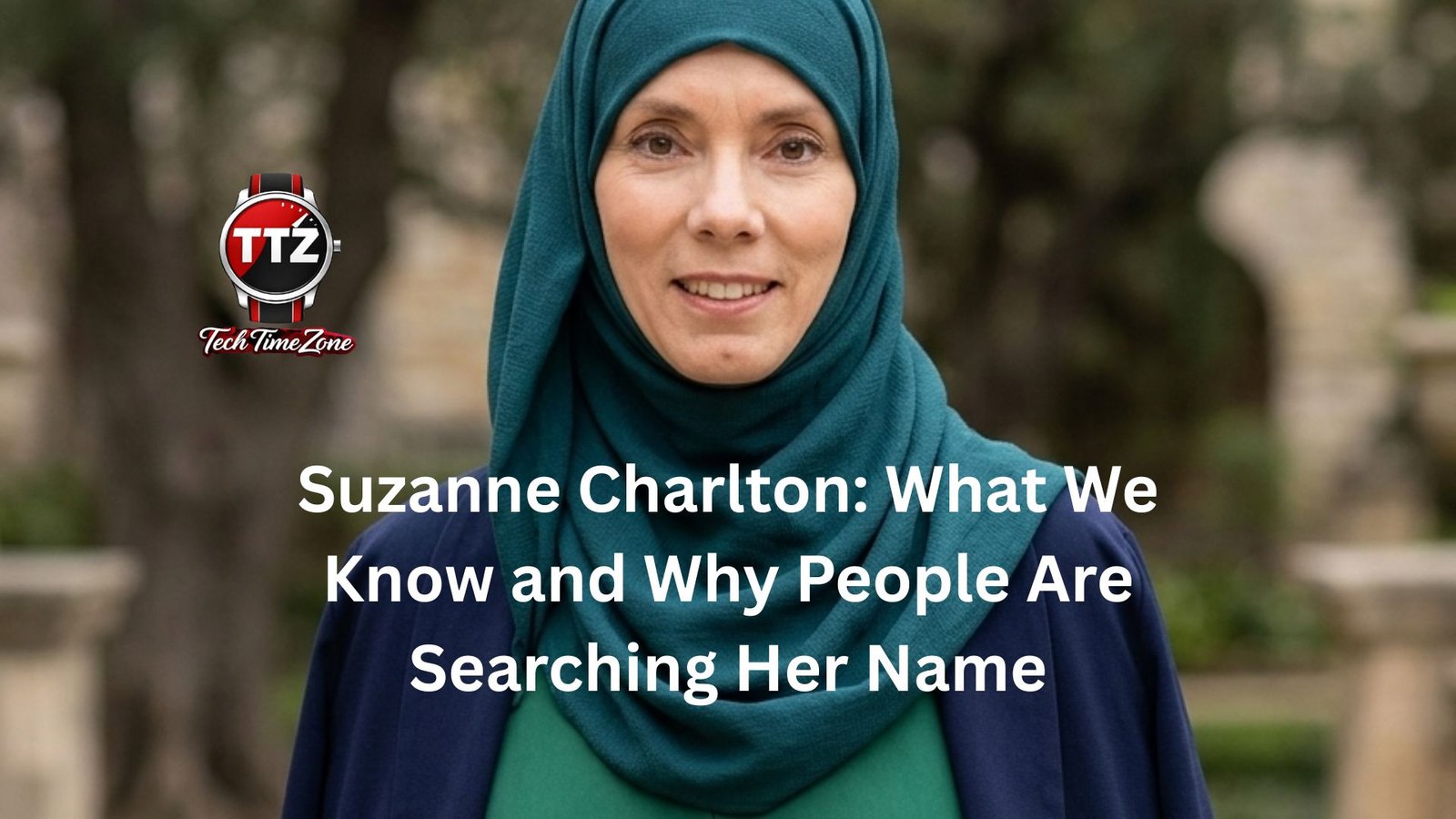
Some names pop up online and quietly gather attention. Suzanne Charlton is one of those names. Not a celebrity splashed across headlines, not a viral personality, but someone people are clearly curious about. Searches don’t spike for no reason. There’s always a story, or at least the hint of one.
And that’s where things get interesting.
Because when you start looking into Suzanne Charlton, you quickly realize this isn’t a neatly packaged public figure with a Wikipedia page and a list of achievements tied up with a bow. Instead, you’re dealing with something more familiar, more real: a person whose digital footprint is scattered, partial, and a little mysterious.
Let’s unpack that in a way that actually makes sense.
The Curiosity Behind a Name
Here’s the thing about names like Suzanne Charlton—they tend to surface when people are trying to connect dots.
Maybe someone heard the name in passing. Maybe it appeared in a document, a local story, a professional setting, or even a social media thread. It could be tied to a workplace, a school, or a community event. Suddenly, curiosity kicks in.
You’ve probably done this yourself. You hear a name once, then again, and eventually you type it into a search bar just to see what comes up.
Sometimes you find everything. Sometimes almost nothing.
Suzanne Charlton falls closer to that second category, and that actually tells you more than you might think.
When Online Presence Is Quiet
Not everyone lives their life online. In fact, most people don’t—at least not in a way that’s easy to track.
If Suzanne Charlton doesn’t have a strong public-facing profile, there are a few very normal reasons for that. She might work in a field that values privacy. She might simply prefer to keep her personal life offline. Or she might exist in digital spaces that aren’t indexed in obvious ways.
Think about a teacher in a small town. Or a healthcare worker. Or someone in administration. These are people who play important roles, often deeply impactful ones, but they’re not building personal brands or posting daily updates.
Their influence is local. Their reputation spreads through word of mouth, not algorithms.
And honestly, there’s something refreshing about that.
The Many Possible Suzanne Charltons
Another layer to this is simple math. Names repeat.
There’s a good chance there isn’t just one Suzanne Charlton. There could be several—across different countries, industries, and age groups. When you search the name, you might be seeing fragments of multiple people blended together.
That’s where things can get confusing.
You might find a Suzanne Charlton connected to a legal document. Another linked to a community organization. Maybe even one tied to academic work or a professional listing. Without context, it’s hard to know which is which.
It’s a bit like trying to identify someone from a crowd using only their first and last name. You need more detail—location, profession, timeline.
Without that, the picture stays blurry.
Why Some People Stay Off the Radar
Let’s be honest: not everyone wants to be easily found.
There’s a growing awareness around digital privacy. People are more careful about what they share, where they share it, and how permanent it all is. Once something is online, it tends to stick around.
So some individuals choose a different path. Minimal social media. Limited public records. No personal websites. No interviews or features.
If Suzanne Charlton is one of those people, then the lack of information isn’t an oversight. It’s a choice.
And it’s becoming more common.
A friend of mine once deleted every social account he had. Not because anything went wrong—he just didn’t like the idea of being searchable. Now, if you look him up, you’ll find almost nothing. But offline, he’s doing meaningful work, building relationships, living a full life.
That contrast is worth remembering.
The Role of Context in Finding the Right Person
If you’re trying to learn about a specific Suzanne Charlton, context is everything.
Where did you hear the name? Was it tied to a location, like a city or organization? Was it mentioned in a professional setting? A legal context? A social one?
Even a small detail can narrow things down significantly.
For example, “Suzanne Charlton in healthcare” is a very different search from “Suzanne Charlton legal case” or “Suzanne Charlton teacher.” Each one leads you down a different path.
Without that extra piece, you’re essentially searching in the dark.
The Difference Between Public Figures and Private Lives
We’ve gotten used to instant answers. Type a name, get a full profile. Photos, history, opinions, everything laid out.
But that only applies to a small slice of people.
Most individuals—possibly including Suzanne Charlton—live in that wide middle ground. Not hidden, not famous, just… normal. Their lives aren’t documented for public consumption, and that’s not a flaw. It’s just reality.
In fact, it can be a good reminder that not every story is meant to be publicly accessible.
Some are meant to stay within communities, families, workplaces.
And that’s okay.
What People Are Really Looking For
When someone searches a name like Suzanne Charlton, they’re usually trying to answer a specific question.
“Who is this person?”
“Do I know them?”
“Are they connected to something I’ve heard about?”
Sometimes it’s about verification. Other times it’s simple curiosity. Occasionally, it’s something more serious, like checking a professional background or confirming an identity.
But rarely is it just idle browsing.
There’s usually a reason behind the search, even if it’s a small one.
A More Thoughtful Way to Search
If you’re genuinely trying to find information about Suzanne Charlton, it helps to approach it with a bit of patience and care.
Start with what you already know. Add context. Cross-reference details. Avoid jumping to conclusions based on partial information.
It’s surprisingly easy to misidentify someone online, especially when names overlap. And once that happens, it can lead to confusion—or worse, incorrect assumptions.
Taking a slower, more deliberate approach actually gets you closer to the truth.
Why This Matters More Than It Seems
At first glance, this might feel like overthinking a simple name search.
But it points to something bigger.
We’re living in a time where identity and information are tightly linked. A name can open doors—or raise questions. It can connect people or create misunderstandings.
And not every name comes with a clear narrative attached.
Suzanne Charlton, as a search term, sits right in that space. It reminds you that behind every name is a real person, with a life that may or may not be visible online.
That gap between reality and search results is where things get interesting.
The Takeaway
So what can you actually say about Suzanne Charlton?
Not much with certainty—and that’s the point.
The lack of clear, consolidated information doesn’t make the name less meaningful. If anything, it highlights how much of the world still exists outside searchable profiles and curated content.
If you’re looking for a specific Suzanne Charlton, the key is context. Without it, you’re piecing together fragments. With it, the picture becomes clearer.
And if you’re just curious? Then maybe the takeaway is simpler.
Not every name leads to a public story. Some stay quiet. Some stay local. Some belong to people who never intended to be found by a search engine in the first place.
That doesn’t make them less real. If anything, it makes them more so.