When most people hear the word “scientist,” they picture someone from a history book. Maybe Albert Einstein with his wild hair, or Marie Curie working late in a laboratory. Those names deserve their place in history, but science isn’t something that happened in the past. Some of the most influential scientists in the world are alive today, making discoveries that affect how we live, work, travel, and even understand ourselves.
What’s interesting is that many of these scientists have become public figures in their own right. They appear in documentaries, give talks watched by millions, and help shape conversations far beyond research labs. Their work reaches into everyday life, whether people realize it or not.
The scientists making headlines today aren’t all working on the same problems. Some are exploring the mysteries of the universe. Others are tackling climate change, disease, genetics, or artificial intelligence. Together, they’re helping answer questions that previous generations could only dream about.
The New Face of Modern Science
Science today looks very different from what it did even thirty years ago.
A researcher can collaborate with teams across continents without leaving their office. Massive amounts of data can be analyzed in hours instead of months. Discoveries spread around the world almost instantly.
Because of this, modern scientists often wear multiple hats. They’re researchers, communicators, educators, and sometimes even public advocates.
Take a simple example. A climate scientist might spend the morning analyzing satellite data, then spend the afternoon speaking to policymakers or answering questions from journalists. The boundaries between science and public life have become much thinner.
That’s one reason why some scientists have become household names.
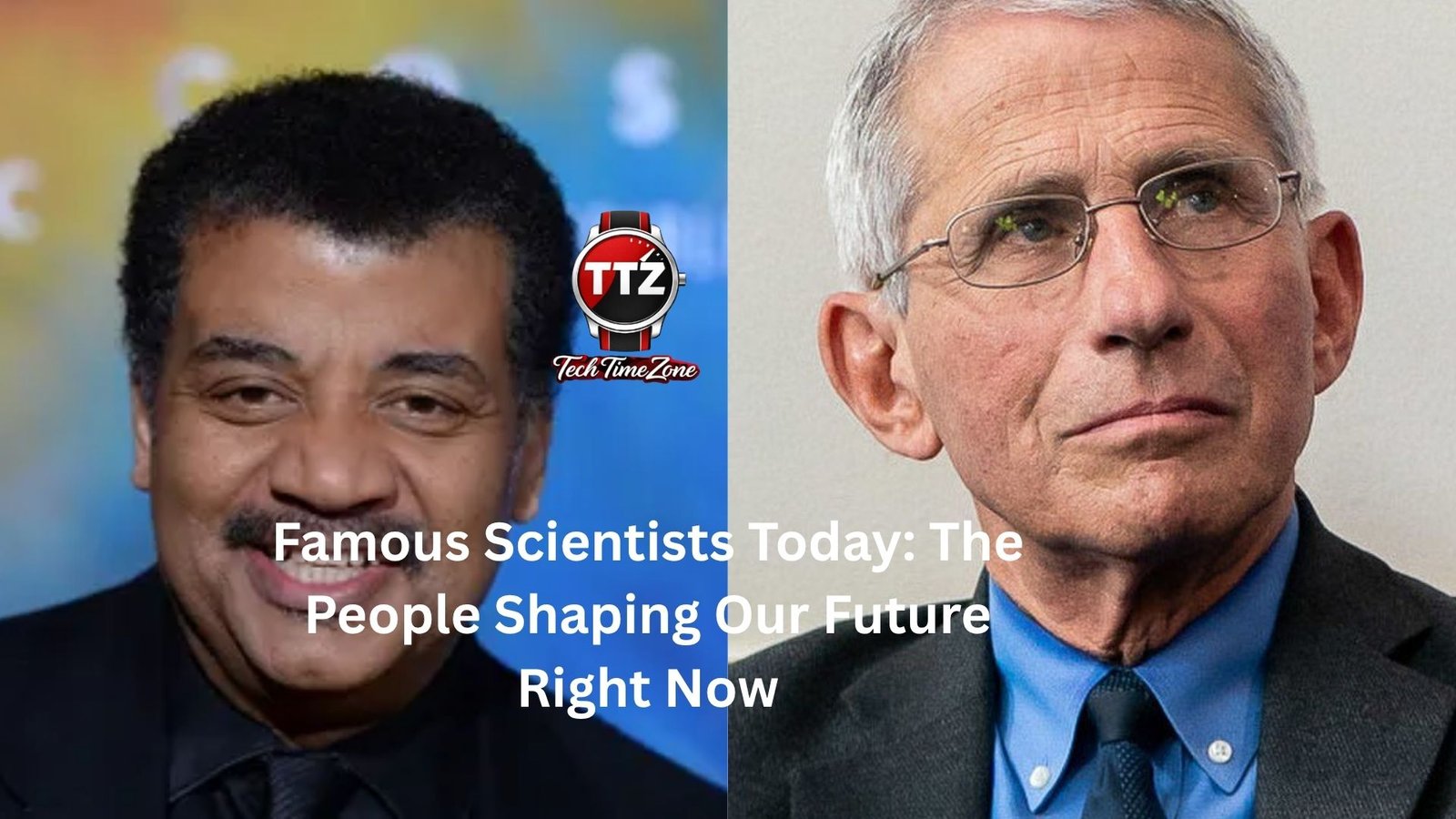
Neil deGrasse Tyson and the Art of Making Science Accessible
Few scientists have done more to bring science into everyday conversations than Neil deGrasse Tyson.
An astrophysicist by training, Tyson has built a reputation for explaining complex ideas in ways that make people stop and think. He doesn’t just talk about stars and galaxies. He connects scientific thinking to ordinary life.
Many people who have never opened an astronomy textbook can still explain concepts like black holes or cosmic expansion because they’ve heard Tyson discuss them in interviews, podcasts, or television appearances.
Here’s the thing: being a great scientist doesn’t automatically make someone a great communicator. Tyson stands out because he can do both.
His influence shows how important communication has become in modern science. Discoveries matter, but helping people understand them matters too.
Jennifer Doudna and the Gene Editing Revolution
Some scientists become famous because their work changes entire fields.
Jennifer Doudna is one of those people.
She played a key role in developing CRISPR gene-editing technology, a breakthrough that has transformed genetic research. The technology allows scientists to make precise changes to DNA in ways that were once difficult or impossible.
The potential applications are enormous. Researchers are studying treatments for genetic diseases, exploring new medical therapies, and investigating ways to improve agriculture.
What makes Doudna’s story particularly fascinating is that the technology she helped develop raises important ethical questions alongside scientific opportunities.
Imagine doctors one day being able to correct certain inherited diseases before they cause suffering. That possibility is exciting. At the same time, it forces society to think carefully about how such powerful tools should be used.
Scientists today often find themselves at the center of conversations that go far beyond science itself.
Jane Goodall’s Lasting Influence
Not every famous scientist works in a high-tech laboratory.
Jane Goodall remains one of the most respected scientific voices in the world, decades after her groundbreaking studies of chimpanzees.
Her observations changed how scientists understand animal behavior. Before her work, many assumptions about the differences between humans and animals were widely accepted. Goodall’s research challenged those beliefs.
What continues to make her influential today is her ability to connect scientific knowledge with environmental action.
People often remember the images of her sitting quietly among chimpanzees. What sometimes gets overlooked is how much patience that work required. There were no shortcuts. No advanced software. Just careful observation over many years.
In a world obsessed with speed, that’s a powerful reminder that some discoveries still depend on persistence.
Climate Scientists Are Becoming Global Voices
Climate change has pushed many scientists into public view.
Researchers such as Michael Mann, Katharine Hayhoe, and Johan Rockström have become recognized voices in discussions about the planet’s future.
Their work helps governments, businesses, and communities understand environmental risks and possible solutions.
Climate science can sometimes feel overwhelming because the topic is so large. Rising temperatures, extreme weather, changing ecosystems, and energy transitions all intersect.
What many leading climate scientists do particularly well is translate complex research into practical implications.
For example, when a city plans flood defenses or a company evaluates long-term infrastructure investments, scientific research often sits behind those decisions.
The work may not always generate dramatic headlines, but it affects real people in very real ways.
The Scientists Exploring Space’s Biggest Mysteries
Humanity’s fascination with space hasn’t faded.
If anything, it has grown stronger.
Scientists such as Sara Seager, Brian Cox, and others continue pushing the boundaries of what we know about the universe.
Sara Seager’s work on exoplanets has helped scientists identify worlds beyond our solar system. Some of these planets exist in regions where conditions might potentially support life.
Pause for a moment and think about that.
A generation ago, many people grew up wondering whether planets existed around other stars. Today, thousands have been identified.
That’s a remarkable shift in human knowledge.
Scientists working in astronomy and astrophysics are answering questions that once belonged entirely to science fiction.
Medical Researchers Are Transforming Healthcare
The COVID-19 pandemic reminded the world how important scientific research really is.
Names like Katalin Karikó became widely recognized because of contributions to mRNA technology, which helped enable groundbreaking vaccines.
For years, much of this research happened outside public attention. Then suddenly, millions of people became interested in vaccine development, virus transmission, and immunology.
That’s one of the unusual things about science.
A discovery can spend decades in relative obscurity before becoming critically important overnight.
Medical scientists continue working on challenges that affect nearly every family in some way. Cancer treatments, Alzheimer’s research, genetic therapies, and infectious disease prevention remain active areas of investigation.
Many breakthroughs happen gradually rather than dramatically. Small advances build on previous work until a major leap becomes possible.
Why Public Trust Matters More Than Ever
Today’s scientists operate in a very different environment than scientists of previous generations.
Information travels instantly. Unfortunately, misinformation does too.
That means researchers increasingly spend time explaining not only what they know but also how scientific knowledge is developed.
Science isn’t a collection of perfect answers. It’s a process for testing ideas, gathering evidence, and refining understanding.
Let’s be honest. That process can sometimes seem frustrating because it doesn’t always provide immediate certainty.
People often want clear yes-or-no answers. Scientific research frequently offers probabilities, confidence levels, and ongoing investigation instead.
The scientists who communicate effectively help bridge that gap. They make uncertainty understandable without undermining trust.
That’s becoming one of the most valuable skills in modern science.
The Rise of Collaborative Discovery
Another major difference today is that scientific breakthroughs are rarely the work of a single genius working alone.
Large research teams have become the norm.
A medical breakthrough might involve geneticists, computer scientists, physicians, engineers, statisticians, and data analysts working together.
The image of the lone scientist making world-changing discoveries still exists in popular culture, but reality is often far more collaborative.
This doesn’t make individual scientists less important. It highlights how complex today’s challenges have become.
Whether researchers are studying climate systems, cancer biology, or deep space, solving these problems usually requires expertise from many different fields.
The most famous scientists today often succeed not just because they’re brilliant researchers but because they’re skilled collaborators.
What Makes a Scientist Famous Today?
Fame in science doesn’t always come from winning awards or publishing research papers.
Visibility matters.
Communication matters.
Impact matters.
Some scientists become famous because they make groundbreaking discoveries. Others gain recognition because they help millions understand difficult topics. A few manage to do both.
What’s refreshing is that modern scientific fame increasingly rewards accessibility. People appreciate researchers who can explain complicated ideas without talking down to their audience.
A scientist who helps a teenager become curious about genetics or astronomy may have an influence that extends far beyond any single study.
That kind of impact is difficult to measure, but it’s incredibly valuable.
Looking Ahead
The famous scientists of today are doing more than expanding human knowledge. They’re helping shape the future in real time.
Whether they’re editing genes, studying climate systems, exploring distant planets, or developing medical breakthroughs, their work affects decisions being made right now.
Some names will eventually end up in history books. Others may be less remembered by the general public, even if their contributions prove just as important.
What matters most is that scientific discovery continues moving forward.
The challenges facing the world are complex, but so is the talent working to solve them. And if history teaches us anything, it’s that today’s researchers often uncover possibilities that seem impossible until they suddenly become reality.
That’s part of what makes following modern science so fascinating. We’re not just reading about history. We’re watching it happen.